Exploring the Role of AR Glasses in Modern Design and Communication
Understanding the AR Glasses Icon in Digital Contexts
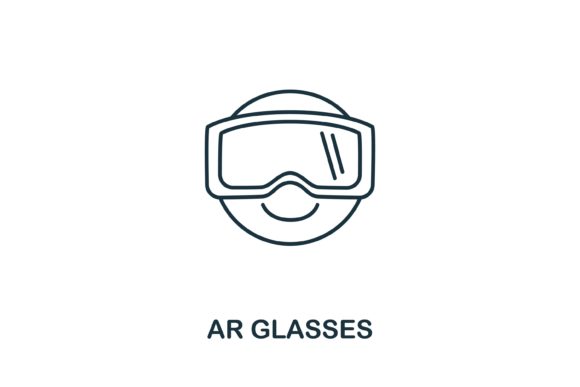
The AR glasses icon has become a recognizable symbol in the world of design, especially in web development, infographics, and digital templates. Representing the broader concept of augmented reality, this simple line element communicates the integration of digital overlays into real-world experiences. Whether used as a logo, a symbol, or a navigational element, the AR glasses icon serves as a visual cue for immersive technology.
Designers often rely on vector-based graphics such as EPS and JPG files to ensure scalability and clarity across various platforms. These formats allow for easy editing and adaptation, making them ideal for use in presentations, websites, and mobile applications. The simplicity of the AR glasses icon makes it versatile for both minimalist and complex design schemes.
Practical Applications of AR Glasses Symbols in Design Workflows
In the realm of web design, the AR glasses icon is frequently used to indicate augmented reality features or integrations. For example, an e-commerce site might use the icon to highlight a virtual try-on feature, allowing users to visualize products in their own space before purchasing. Similarly, educational platforms may use the symbol to denote interactive 3D models or immersive learning modules.
- Enhances user interface navigation by signaling AR-enabled features
- Supports intuitive interaction in mobile and desktop applications
- Acts as a branding element for companies focused on immersive technologies
Infographic designers also benefit from incorporating the AR glasses icon. When visualizing trends in technology or explaining the evolution of human-computer interaction, the icon helps communicate the concept of augmented reality without requiring lengthy explanations. It can be paired with statistics or timelines to illustrate growth in AR adoption across industries.
Choosing the Right Format: EPS vs. JPG for AR Graphics
When working with AR glasses icons, choosing the appropriate file format is crucial. EPS (Encapsulated PostScript) files are ideal for vector graphics, allowing designers to resize the icon without loss of quality. This is especially important for print materials, large-format signage, or high-resolution digital displays.
On the other hand, JPG files are raster-based and best suited for web use where file size and load time are important considerations. While JPGs may not scale as cleanly as EPS files, they are widely compatible with image editing software and content management systems.
- Evaluate the use case: Will the icon be printed or displayed digitally?
- Consider scalability: Does the design require resizing across multiple platforms?
- Check compatibility: Is the format supported by your design tools or CMS?
Many designers opt to work with both formats—using EPS for initial edits and exporting to JPG for final deployment. This dual-format approach ensures flexibility and maintains visual integrity across different mediums.
Who Benefits from Using AR Glasses Icons?
The AR glasses icon is not limited to a single industry or user group. Its broad applicability makes it valuable for:
- Web designers integrating AR features into responsive layouts
- UI/UX professionals crafting intuitive augmented reality interfaces
- Educators developing interactive learning tools and simulations
- Marketers promoting AR-based products and services
- Developers building AR-enabled applications and platforms
Businesses leveraging augmented reality to enhance customer engagement often find that the AR glasses icon helps bridge the gap between technology and user understanding. It acts as a familiar touchpoint that invites exploration and interaction.
Integrating AR Symbols into Branding and Marketing
For companies developing AR-based products or services, the AR glasses icon can become a central element of their branding strategy. Used consistently across digital assets, packaging, and promotional materials, it reinforces brand identity and communicates innovation.
Marketing campaigns that incorporate the AR glasses icon can benefit from increased user engagement. For example, a retail brand launching an AR-powered shopping app might use the icon in social media posts, email newsletters, and landing pages to guide users toward the new feature.
Additionally, the icon can be part of a larger visual language that includes other AR-related graphics such as holograms, depth sensors, or gesture controls. This cohesive approach ensures that users quickly recognize and understand the augmented capabilities of a product or service.
Future Trends in AR Symbol Design
As augmented reality continues to evolve, so too will the visual language used to represent it. The AR glasses icon is likely to undergo refinements in style, color, and interactivity to better align with emerging design trends and user expectations.
One emerging trend is the use of animated AR icons that respond to user interaction. For instance, a subtle animation might activate when a user hovers over the icon, providing a preview of the AR experience. This dynamic approach enhances engagement and provides immediate feedback to the user.
Designers may also begin to incorporate more contextual variations of the AR glasses icon. A version with a transparent lens might indicate a see-through display, while a stylized version with integrated sensors could represent advanced hardware features. These nuanced designs help users better understand the specific AR capabilities being offered.
Best Practices for Using AR Glasses Icons in Design Projects
To ensure effective use of the AR glasses icon in any design project, consider the following best practices:
- Maintain visual consistency: Use the same style and color palette as the rest of your design elements.
- Provide clear context: Pair the icon with descriptive text or tooltips to avoid ambiguity.
- Optimize for accessibility: Ensure sufficient contrast and legibility for users with visual impairments.
- Test across devices: Confirm that the icon appears clearly on both mobile and desktop screens.
Designers should also stay updated with evolving AR standards and terminology. As the technology matures, new symbols and conventions may emerge that better reflect the capabilities of modern augmented reality systems.
Conclusion
The AR glasses icon is more than just a design element—it’s a bridge between physical and digital worlds. Whether used in web interfaces, marketing materials, or educational tools, it plays a critical role in guiding users through augmented experiences. With the availability of vector graphics, EPS files, and JPG files, integrating this symbol into any project has never been easier.
As augmented reality becomes more integrated into everyday life, the visual language surrounding it will continue to evolve. By staying informed and adaptable, designers and developers can ensure that their use of the AR glasses icon remains both relevant and effective.